Manhattan’s Chinatown was not built through a single development plan or by constructing new
buildings from the ground up. Instead, it formed gradually through Chinese immigrants who
adapted existing spaces, created businesses, and built social networks that allowed the
neighborhood to grow over time. Chinatown first developed in the late nineteenth century
around Mott, Pell, and Doyers Streets. Rather than constructing new buildings, Chinese
immigrants reshaped existing tenements—brick structures between two and five stories
tall—into boarding houses, restaurants, laundries, grocery stores, herbal medicine shops, and
small apartments. Buildings were reorganized for dense living and mixed commercial use:
storefronts occupied the ground floor while upper levels housed workers and families. Through
this process, ordinary Lower Manhattan buildings gradually took on a distinct identity.
buildings from the ground up. Instead, it formed gradually through Chinese immigrants who
adapted existing spaces, created businesses, and built social networks that allowed the
neighborhood to grow over time. Chinatown first developed in the late nineteenth century
around Mott, Pell, and Doyers Streets. Rather than constructing new buildings, Chinese
immigrants reshaped existing tenements—brick structures between two and five stories
tall—into boarding houses, restaurants, laundries, grocery stores, herbal medicine shops, and
small apartments. Buildings were reorganized for dense living and mixed commercial use:
storefronts occupied the ground floor while upper levels housed workers and families. Through
this process, ordinary Lower Manhattan buildings gradually took on a distinct identity.
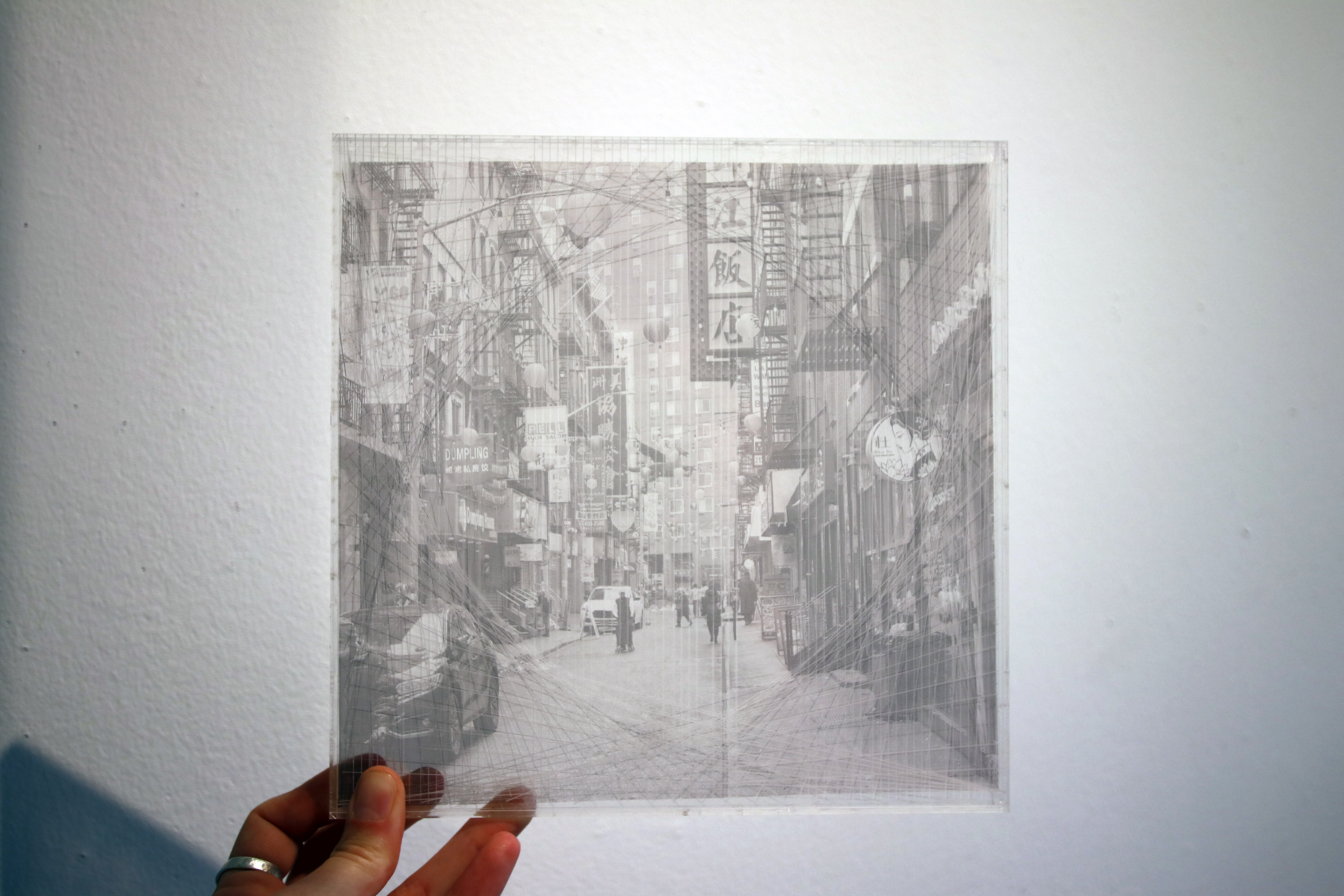
Today’s Chinatown is shaped not only by the Chinese immigrant community that built it, but also
by external perceptions that framed it as an “exotic” urban enclave. From its early development,
the neighborhood was interpreted through cultural otherness, where visitors and media
emphasized mystery and spectacle. This reinforced visible cultural markers—dense signage,
street life, and symbolic architecture—that made Chinatown legible as “Chinese” to outsiders.
Chinatown becomes a hypervisible space where language, food, and builtform signal cultural
identity, even as the community remains diverse and changing. This echoes Jean Baudrillard’s
concept of hyperreality, according to which representations no longer refer back to an original
reality but replace it, producing signs detached from their origin.
by external perceptions that framed it as an “exotic” urban enclave. From its early development,
the neighborhood was interpreted through cultural otherness, where visitors and media
emphasized mystery and spectacle. This reinforced visible cultural markers—dense signage,
street life, and symbolic architecture—that made Chinatown legible as “Chinese” to outsiders.
Chinatown becomes a hypervisible space where language, food, and builtform signal cultural
identity, even as the community remains diverse and changing. This echoes Jean Baudrillard’s
concept of hyperreality, according to which representations no longer refer back to an original
reality but replace it, producing signs detached from their origin.
Chinatown is indeed a hyperreal space—neither fully traditional nor invented, but sustained by
the interplay between immigrant history and external imagination. With my intervention I aim to
transform Baudrillard’s melancholic diagnosis of modernity into an active milieu where residents
seize tools of signage and redirect them towards collective making. The project’s site is
positioned between the New York City Criminal Court—once tied to state authority—and the
surrounding fabric of Chinatown. Instead of a fixed façade, residents are given tools to fabricate
and install custom-designed panels, turning their building into a continuously authored
surface—a living façade. Unlike the unplanned tenement adaptations of the 1870s, this project
deliberately engineers the conditions for adaptation giving residents a structural armature that
invites change rather than merely tolerating it. In the tower of houses next to Chuck Pak, each
panel is a public expression of how Chinatown is lived and redefined by its inhabitants. On the
other side of the site, on the criminal court, the vertical façade challenges both state authority
and the historical projection of an “exotic” Chinatown, replacing imposed narratives with
resident-generated form. Power is redistributed through a spatial mechanism of making, where
citizenship is enacted through construction and the image of Chinatown is continuously
produced from within.
the interplay between immigrant history and external imagination. With my intervention I aim to
transform Baudrillard’s melancholic diagnosis of modernity into an active milieu where residents
seize tools of signage and redirect them towards collective making. The project’s site is
positioned between the New York City Criminal Court—once tied to state authority—and the
surrounding fabric of Chinatown. Instead of a fixed façade, residents are given tools to fabricate
and install custom-designed panels, turning their building into a continuously authored
surface—a living façade. Unlike the unplanned tenement adaptations of the 1870s, this project
deliberately engineers the conditions for adaptation giving residents a structural armature that
invites change rather than merely tolerating it. In the tower of houses next to Chuck Pak, each
panel is a public expression of how Chinatown is lived and redefined by its inhabitants. On the
other side of the site, on the criminal court, the vertical façade challenges both state authority
and the historical projection of an “exotic” Chinatown, replacing imposed narratives with
resident-generated form. Power is redistributed through a spatial mechanism of making, where
citizenship is enacted through construction and the image of Chinatown is continuously
produced from within.
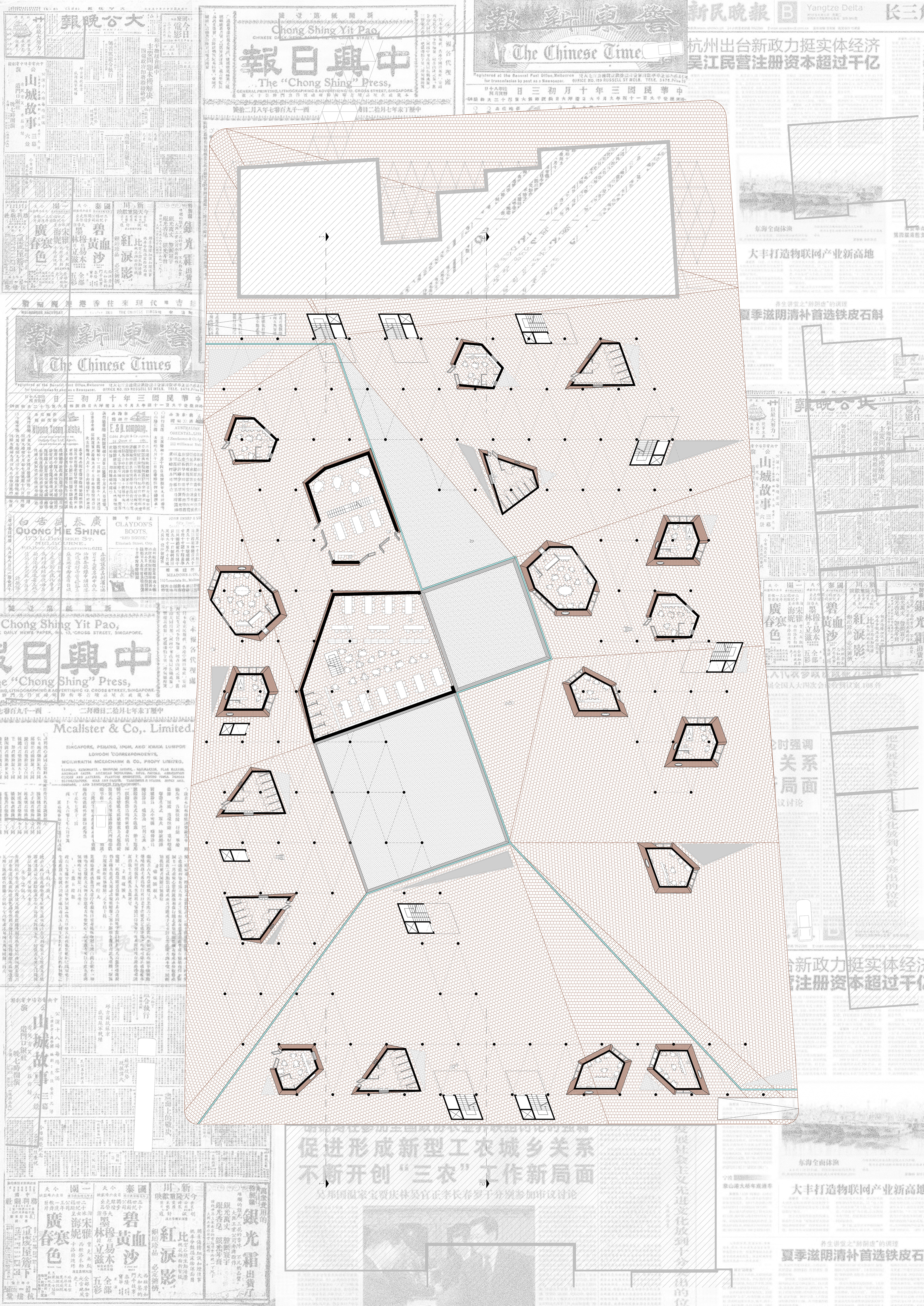
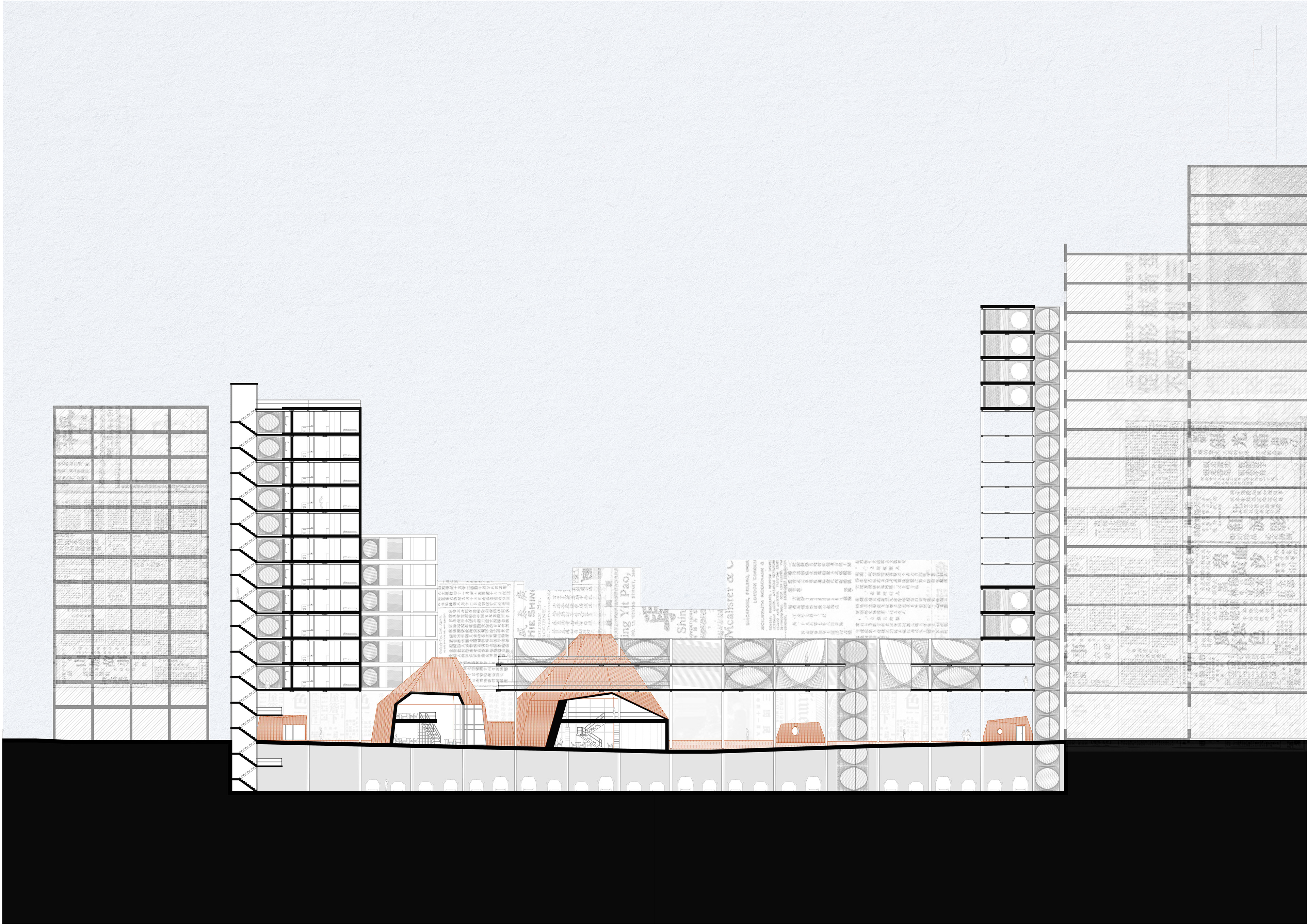
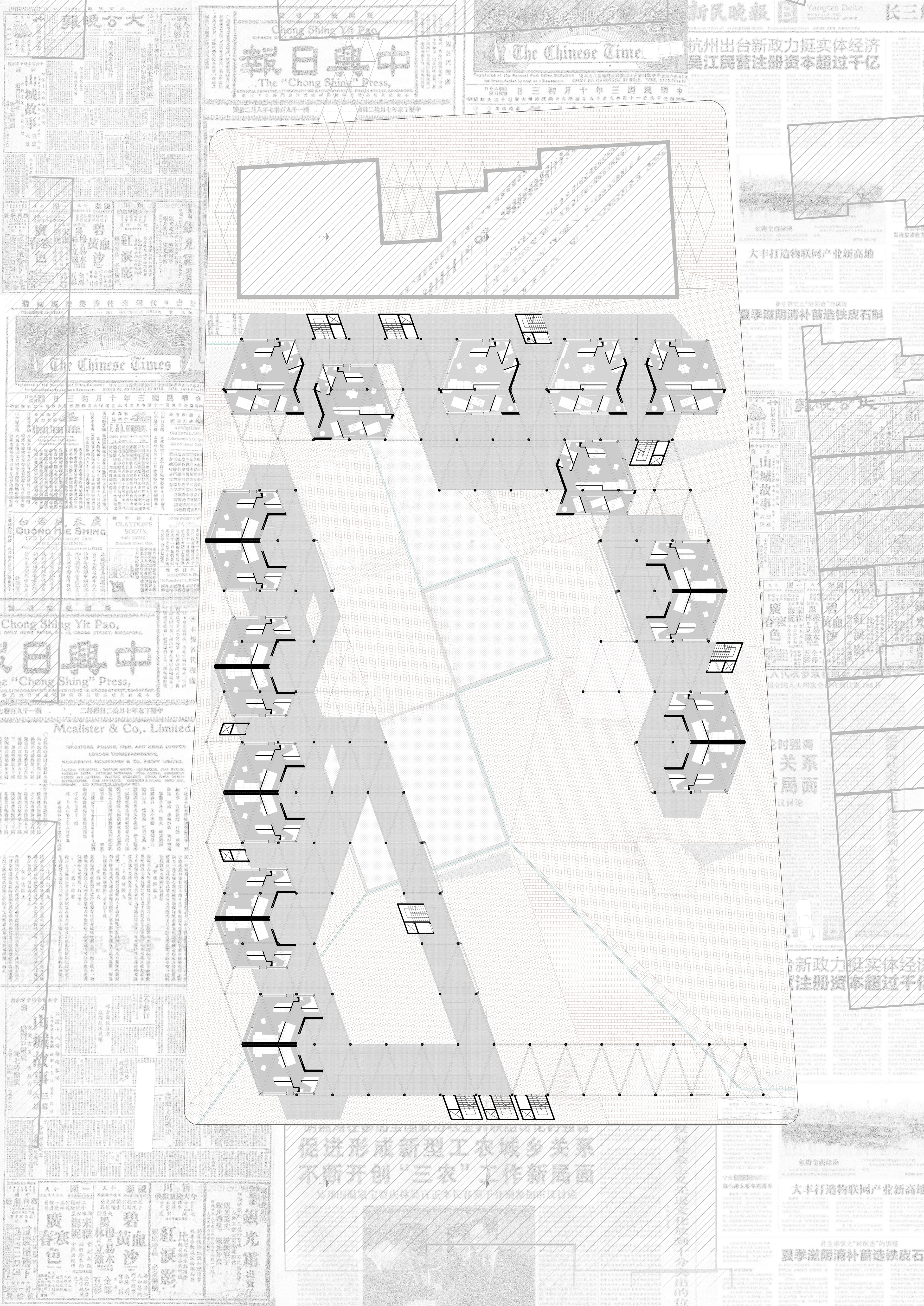
The complex is organized with permanent functions located on the ground floor within large
brick structures—echoing the logic of old tenements. Stability grounds the gaze of residents
looking down from their “city in the sky” apartments - their changing neighborhoods.
My narration reads as follows:
The triangular metal scaffolding suspends the city between ground and sky. It rises before the
criminal court, a failed monument of state authority now hollow, and climbs its face. Below, red
brick anchors hold the permanent: a community center, a digital fabrication lab, cafés, retail, and
two square slabs that transform into a performance space. Above, a semi-transparent tower of
fiber, metal, and concrete allows each resident to fabricate their own panel in the fab lab and
slide it into the concrete frame, forming personal cocoons, homes shaped by need and
imagination. Together these cocoons form a shifting façade, a living surface. Across from the
tower, another cluster of cocoons climbs the criminal court: a vertical Chinatown. The first
Chinatown (1870s) was built by immigrants carrying knowledge from afar, layers of memory and
adaptation. This Chinatown does not simulate a lost original. It is a simulacrum in Baudrillard's
sense: a hyperreality that replaces representation with construction. Unlike passive consumer
simulations, however, this hyperreality is actively built by its residents. Each panel is a
constructed reality, visible and intentional. The façade never settles into a single image, yet the
whole feels inevitable because every cocoon was made by someone who lives there. Thus, the
vertical Chinatown is not a monument to diaspora nor a nostalgic pastiche. It is a new civic
space defined by oscillation: between brick anchors (containment, permanence) and fiber
cocoons (release, mutability); between the court's frozen authority and the living surface that
climbs it. A stage for hyperreal citizenship, built by its citizens, panel by panel. Just as the
original Chinatown was an act of making from memory, this is an act of making from possibility.
Entirely of its time.
criminal court, a failed monument of state authority now hollow, and climbs its face. Below, red
brick anchors hold the permanent: a community center, a digital fabrication lab, cafés, retail, and
two square slabs that transform into a performance space. Above, a semi-transparent tower of
fiber, metal, and concrete allows each resident to fabricate their own panel in the fab lab and
slide it into the concrete frame, forming personal cocoons, homes shaped by need and
imagination. Together these cocoons form a shifting façade, a living surface. Across from the
tower, another cluster of cocoons climbs the criminal court: a vertical Chinatown. The first
Chinatown (1870s) was built by immigrants carrying knowledge from afar, layers of memory and
adaptation. This Chinatown does not simulate a lost original. It is a simulacrum in Baudrillard's
sense: a hyperreality that replaces representation with construction. Unlike passive consumer
simulations, however, this hyperreality is actively built by its residents. Each panel is a
constructed reality, visible and intentional. The façade never settles into a single image, yet the
whole feels inevitable because every cocoon was made by someone who lives there. Thus, the
vertical Chinatown is not a monument to diaspora nor a nostalgic pastiche. It is a new civic
space defined by oscillation: between brick anchors (containment, permanence) and fiber
cocoons (release, mutability); between the court's frozen authority and the living surface that
climbs it. A stage for hyperreal citizenship, built by its citizens, panel by panel. Just as the
original Chinatown was an act of making from memory, this is an act of making from possibility.
Entirely of its time.