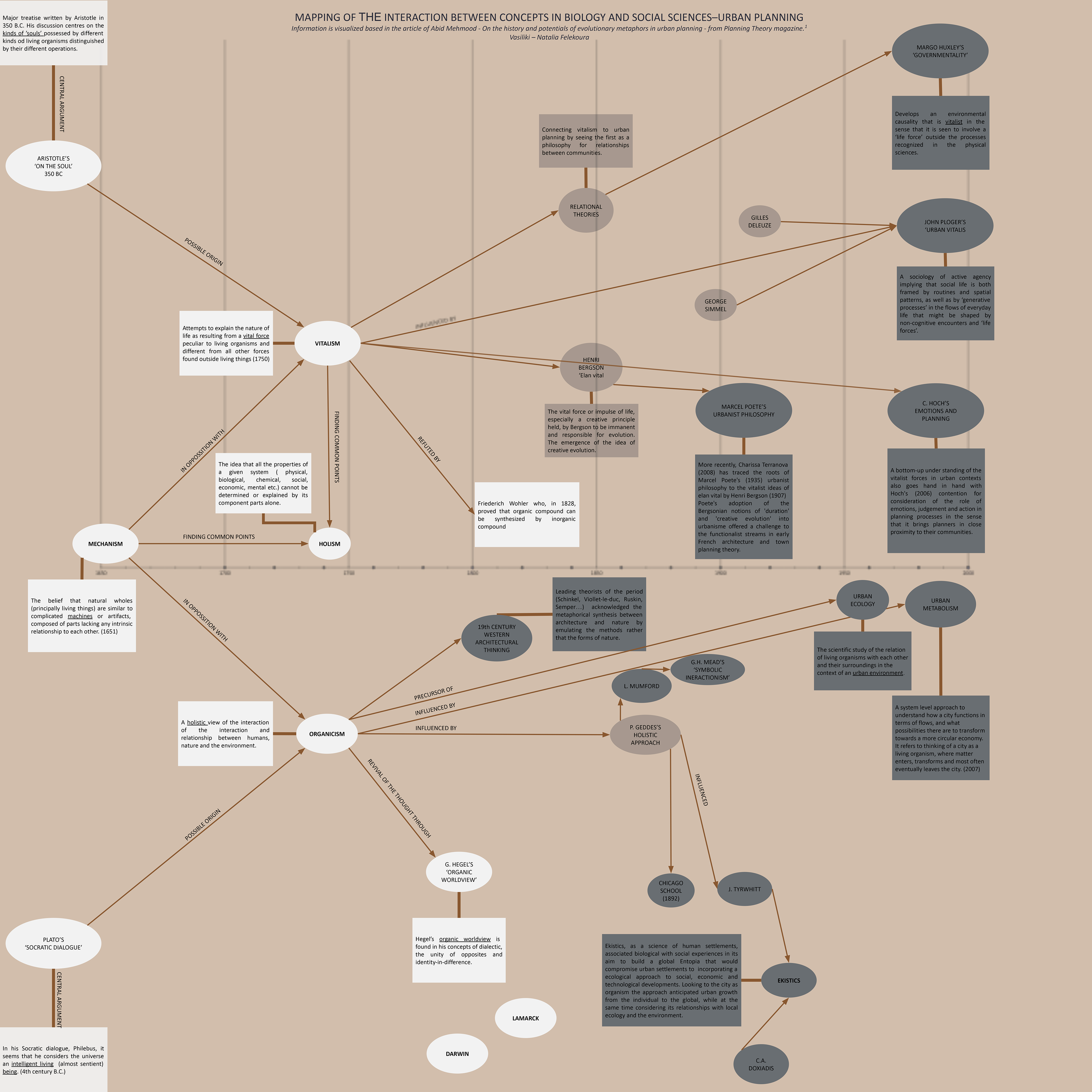
The discussion on human settlements as complex systems and the importance that different architects, urban planners and other scientists attributed to them has led us to explore some key moments in the evolution of the urban planning thought of the 20th century. In this evolution, we recognize the functionalist urbanism of the 1920s and 1930s as the first major current, and the science of human settlements, called Ekistics, as the second current. In order to better comprehend the transition from the first 'school' of thought to the second one, we focus on the comparison of the two distinctive urban grids that each school of thought developed, since we believe that these grids encapsulate, in an abstract way, the distinct conception of the city that each one advocated.
Thus, we first refer to the 7th C.I.A.M., as a conference that summed up the principles of functionalist urbanism (on the basis of the Charter of Athens) and in particular the Amsterdam survey, which led to the formation of the first grid we are studying. This urban planning viewpoint seems to be determined by a certain staticness, expressed in the separation of functional zones, and the coding and reduction of urban factors in singular elements. Correspondingly, in Ekistics, the concept of scale-in-time, the concept of change, the concept of locality, and a diffuse interdisciplinarity are identified as the main elements that characterize the science of human settlements. In particular, we could argue that the matrix of Ekistics differs from the matrix of the C.I.A.M. in the ways it promotes the systematic significance of the concept of evolution and/or change.
After having identified the qualities that contribute to this paradigm shift, we study the contribution of the British urban planner Jaqueline Tyrwhitt on this adaptive evolution from one grid to the other. Moreover, by looking back at the collaborations that Tyrwhitt initiated and the influences that she received, we identify how she contributed to this paradigm shift from the urban grid of the C.I.A.M. to that of Ekistics. And in this, we cannot but recognize how Tyrwhitt's urbanist conception is largely shaped by the work of the Scottish biologist and urbanist Patrick Geddes.
More specifically, the notion of territory as a basic unit of study, the concepts of circular causality. the hierarchy of social units as well as the qualities of spatio-temporality are transferred over from Geddes' work in order to inform Tyrwhitt's thinking. And this way of looking at the city is clearly influenced by biology. Thus, the idea that the city is a living organism, with an organic structure and interconnected parts, begins to extend from the field of biology to the field of urban planning. It is argued that the origins of this ides lie in the philosophical doctrine of organicism according to which the universe and its various parts (even the inorganic ones) are 'living' and governed by a physical structure, the same way living organisms do. Specifically, it was through Tyrwhitt that Geddes concepts of circular causality and hierarchy of the social units were 'transferred, as general qualities attributed to a 'system' in constent 'change', shaping the new science of Ekistics accordingly.
From a static view of the city to one that considers the city an evolving living organism
Co-author: Kostas Tsiambaos